Overview
I coupled the FEBio finite-element structural solver with an in-house immersed-boundary CFD solver for large-deformation fluid–structure interaction at Vanderbilt University.
The two solvers address different parts of the problem. FEBio handles tissue mechanics, while the immersed-boundary solver handles the flow around a moving structure. The coupling exchanges fluid loads and structural motion during the simulation.
Solver coupling
The flowchart below shows the exchange of interface pressures or tractions, nodal positions, and velocities. Each solver advances its own equations, and the interface iteration checks convergence before completing the time step.
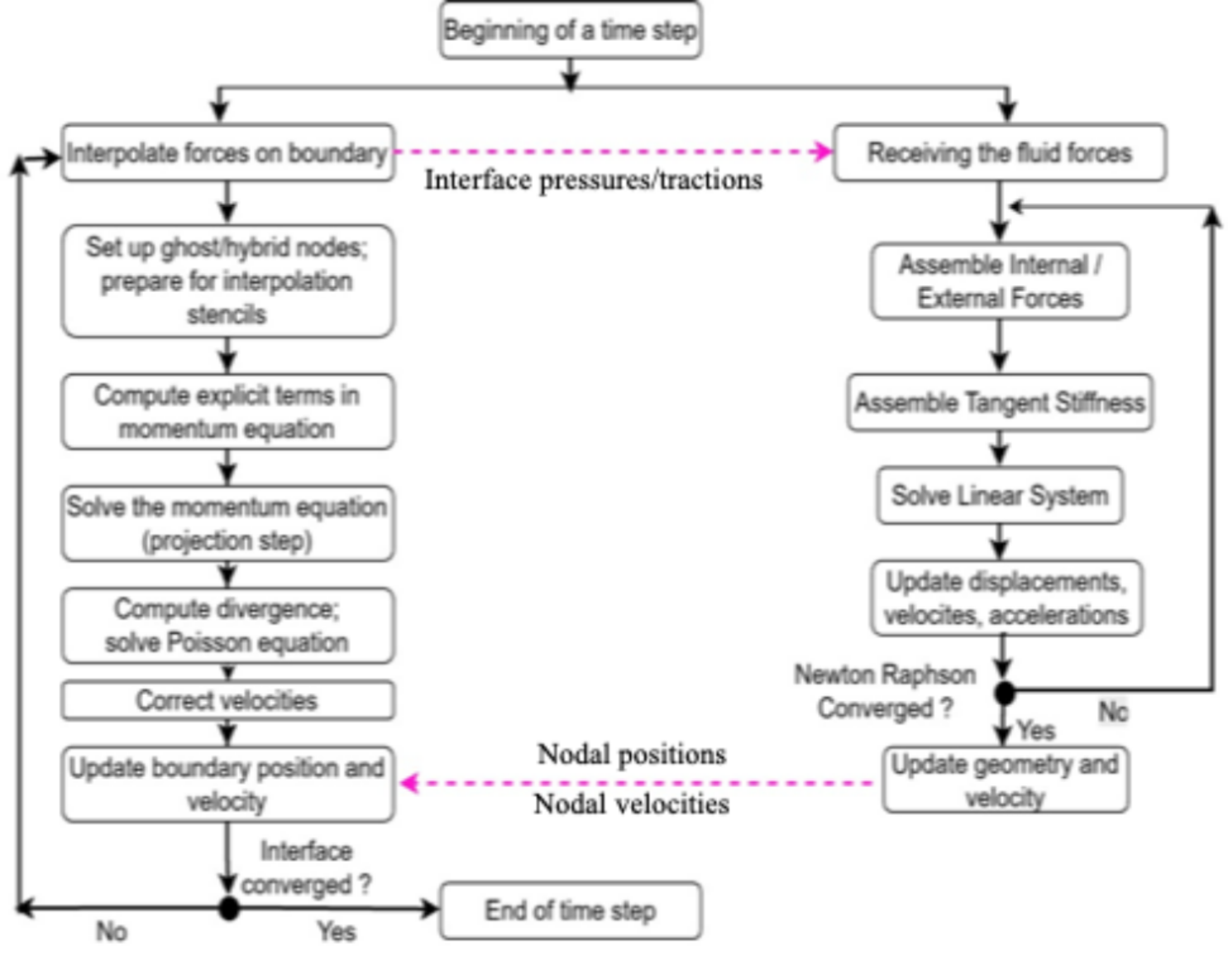
Exchange of fluid loads and structural motion within a coupled time step.
Biological application
The APS conference abstract describes validation against FSI benchmarks and application to bioprosthetic heart valves with nonlinear, hyperelastic, and anisotropic tissue behavior. The study examined pressure gradients, valve-surface pressures, effective orifice area, and flow patterns.
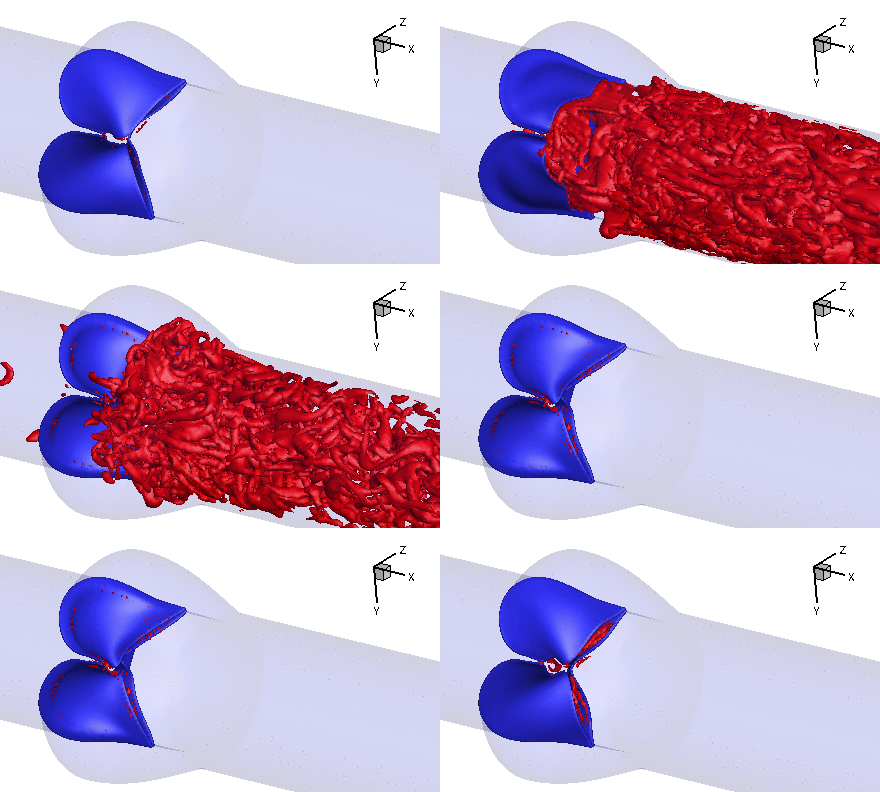
Flow-induced deformation of the valve leaflets.
Valve motion alongside its response history.
My contribution
My work focused on integrating the structural and fluid frameworks for biomedical FSI. The wider collaboration included computational assessment of prosthetic aortic valve designs with California Medical Innovations Institute and Prima Medical Technologies GmbH.
Presentation
Sarkar, N., Li, S., and Luo, H. (2025). A coupled FEBio–immersed boundary framework for fluid-structure interaction in biological applications. 78th Annual Meeting of the APS Division of Fluid Dynamics, Houston, TX. Conference abstract.

FEBio Software Suite.